

Issue 55 - Where do the clients come from?
and how to get more of them. Plus the virtuous feedback loop and a little sketchnote distraction.

Hi - I’m Cara, I’ve been a professional Graphic Recorder and business illustrator since 2006.
You’re reading the Visual Edit, a free newsletter for graphic recorders, live illustrators, sketchnoters and business illustrators. Upgrade to paid and join me in the graphic recorder club for Draw a Better Business posts and podcast extras.

How do I find clients?
How you find clients as a freelance graphic recorder or business illustrator can feel like an impossible mystery wrapped in an enigma; a secret worthy of a movie trilogy and a faded map found next to a wizard’s hat in a cave.
Last year I decided to keep a list of all the enquiries that come into my inbox for 3 months. I don’t do any marketing apart from a bit of inconsistent sharing on social media, and I have never paid for any marketing ads or sponsored posts, but magically I’ve always had enough work. Sometimes just enough and sometimes too much, but over a year it balances out.
Of course I know it’s not magic or accident, rather it’s a result of incremental efforts I’ve put in over the years, plus some luck. But as the world out there is shifting fast I figured it might be helpful to actually know some facts.
So this issue I want to share where my jobs come from, with the hope that it will give you some ideas for where to put your attention when you’re trying to bring clients to your door.
The marketeers amongst you will no doubt be spluttering into your cornflakes at the admission that it’s taken me almost 20 years to do this - my excuse is that because I’ve mostly always had enough work coming in I haven’t had too much of a reason to focus on it.
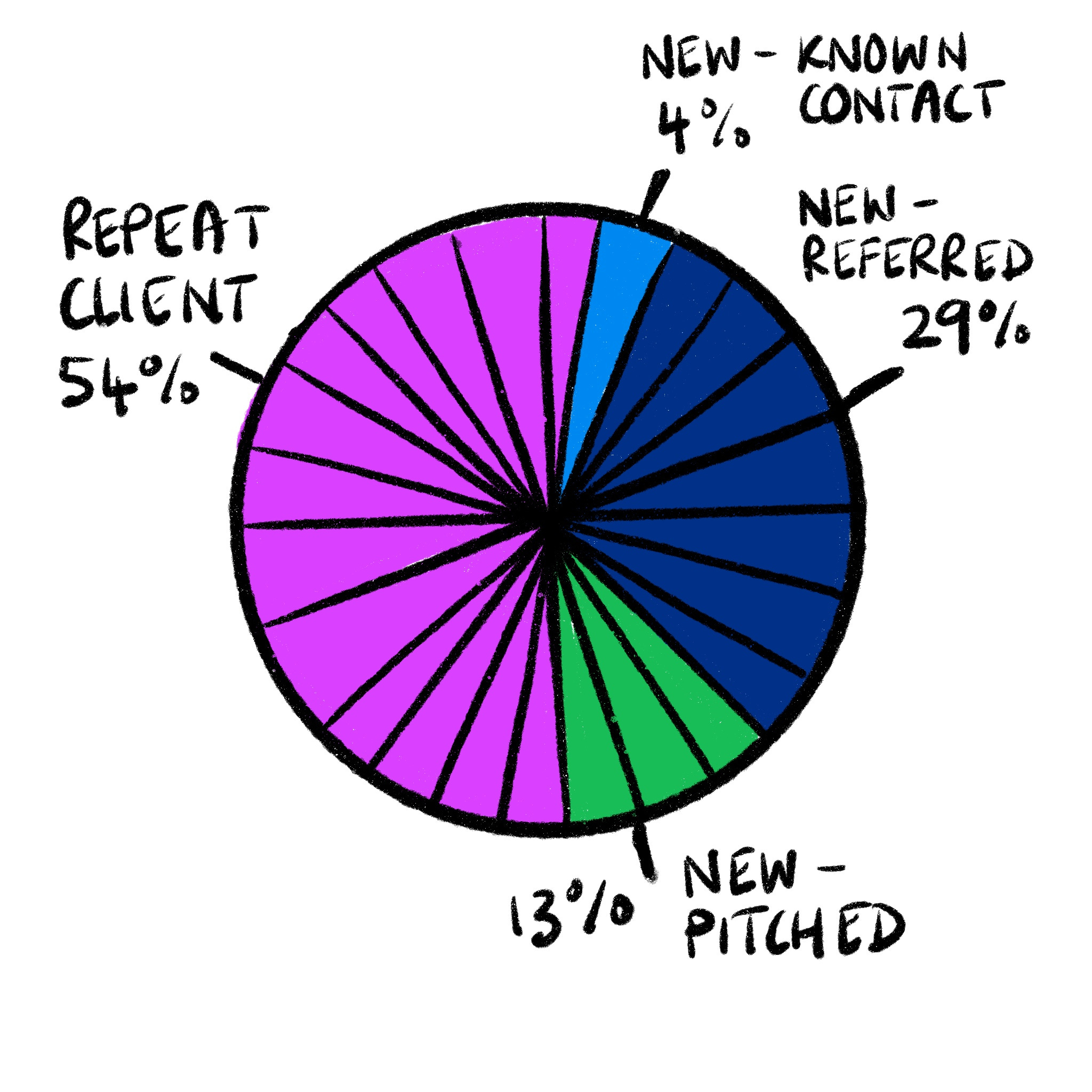
So last year I set out on my little data gathering exercise.
Repeat Clients
As you can see by far the biggest segment is repeat clients, and that was really heartening for me to see.
Benefits of repeat customers
They know you and how you work so the chance of misalignment is very small.
You know them and how they work. You know if they need more chasing, more detail, more reassurance etc. and you can deliver in a way that suits them.
They already know they like what you do and have experienced the value it brought to their work.
You gain subject matter knowledge which allows you to incrementally tailor your offer to their needs.
Trust takes time to grow. You want to be the person the client knows they can count on to deliver what they need.
You do not have to spend time and money finding them. They come to you.
How to get repeat customers
Be thorough at the briefing stage so that people know what to expect and what will be delivered. This minimises misalignment between what the client thinks you’re going to do and what is actually humanly possible.
Be nice. Show an interest in the subject matter. If you have relevant knowledge or experience let them know. This is reassuring and starts to build trust.
Be easy to work with. The people who hired you are busy, and if they are organising an event or important meeting, probably a bit stressed. Brief well (see above) and then be as self-sufficient as possible.
Be professional. Deliver what you said you’d deliver, when you said you’d deliver it.
Follow up. You might not have heard from them for a while so every now and then get in touch - but don’t be spammy. Let’s say you worked at their annual event in December 2025, get in touch 6 months before the next event (June 2026) to say hi and see if they have thought about visual input into this year’s event.
New Client - Referred
These are clients who are new to me, but have been given my details by someone who has previously worked with me. Referrals are magical, they just land in your inbox like a delightful surprise.

Benefit of referrals
They are often from the same organisation, sector or location as the person who referred you so you might already have something in common. Also someone they know liked working with you enough to pass on your details. All of this is great for building trust before you’ve even communicated.
You do not have to spend time and money finding them. They come to you.
People love to recommend a good service. It makes them feel (and look) good. If you now do a good job for the person they referred to you, you have also reinforced the good feels they have for you.
You are now starting to build a network of people who know and trust you. Like a mind map, the more people in this network the more the network will grow.
How to get referrals
Ask! - If you want more clients never be afraid to ask a happy customer if they will refer you on to anyone else that might find your services useful. People love to recommend (see above).
If you are at a gig make sure your contact details are visible on the graphic you create. Then when the person at the organisation you have done good work for gets asked if they know a graphic recorder, they know where to look to find your details.
Thank people who referred to you. If the new person just appeared in your inbox make sure you take a moment to email the referrer and let them know X got in touch and you appreciate them passing on your details.
New Client - Pitched
This is rare for me, but is basically where you’ve seen an opportunity and you’ve put in a proposal or offer to someone you don’t know and who you don’t have a prior connection to. On my piechart the 13% of work in that 3 month period came from just one client and one pitch. The successful pitch expanded from a simple live graphic recording to a pre-event illustration and a post-event animation!
Benefit of pitching
Pitching helps you clarify your offer. It’s useful to do this every now and then to encourage you to keep your information and portfolio up to date.
It widens your network. Certainly to a new person, but perhaps to an entirely new sector.
How to pitch
This deserves a post of its own, but in brief:
Keep alert for opportunities to pitch to.
Have a relevant portfolio to show.
Pull together past experience, examples and feedback to demonstrate you can understand and be trusted with the job.
Be clear on your pricing.
Be interested in what they do and let them know how you can add value.
New Client - known
This is where you’ve not been hired by the client before but you do already know them. They might be a previous work colleague, a social acquaintance or someone you meet at the gym. The client you can see in this category of the pie chart was someone I met on a course many years ago. I connected with them on LinkedIn and stayed in touch over the following years. Out of the blue they moved jobs and were now in a position to approach me about an opportunity.
Benefit of known new clients
As it says in the title, they know you. Perhaps well, perhaps not, but enough to make them think they wouldn’t mind working with you. There is already some trust in place.
You do not have to spend time and money finding them. They come to you.
How to get people to come to you with a work possibility
Connect with people (only where it feels natural, not in a weird way).
Let people know you’re looking for new clients without being salesy. Sales is not the point of your relationship and no one enjoys being pitched to when they thought you were meeting up for a friendly latte.
If you have a good relationship with someone don’t be afraid to ask them if they know anyone that might find your services useful.
Have a clear way to describe what you do, and the benefits of it.
If you haven’t read Issue 52 on this subject you might find it useful:

If you’re already a self-employed visual worker then try making your own pie-chart of clients to see where you’re excelling and where you might want to focus a bit more time.
If you’re new to this world of work and wanting to grow your client base, then hopefully you found this a useful jumping off point. Why not take the HOW TO lists and pin them up next to your desk and work through them one at time this year. Let me know how you get on!

Sketchnote
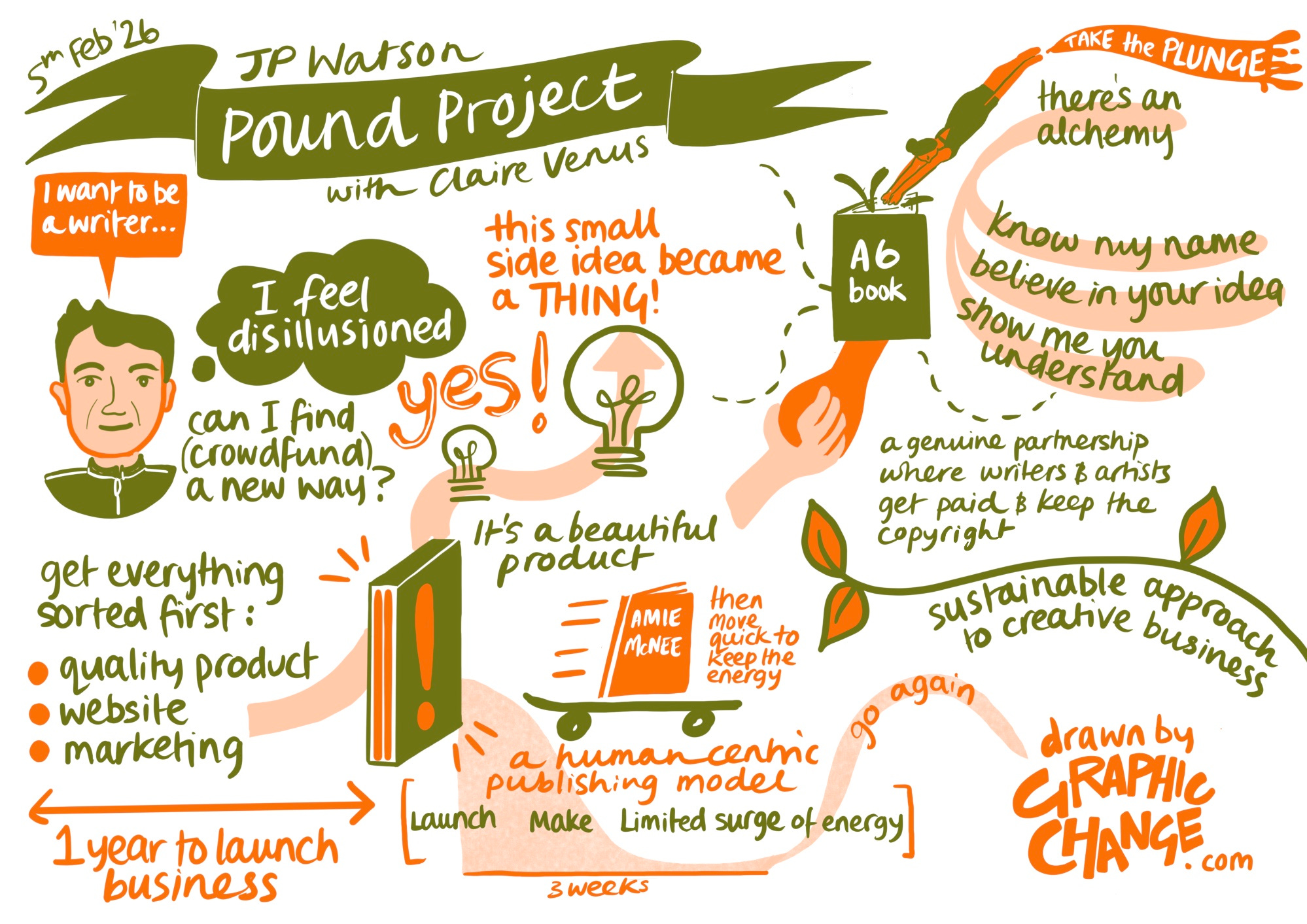
As a bit of visual relief from all that thinking, here’s a live sketchnote I did a few weeks ago of a 40 minute conversation between JP Watson (Pound Project) and Claire Venus on Substack. This wasn’t a job, just me in my own time watching the interview with my iPad. I genuinely listen better while I’m drawing!

Training to be a…
The virtual doors of our online Graphic Change Academy have just opened for 2026 students!
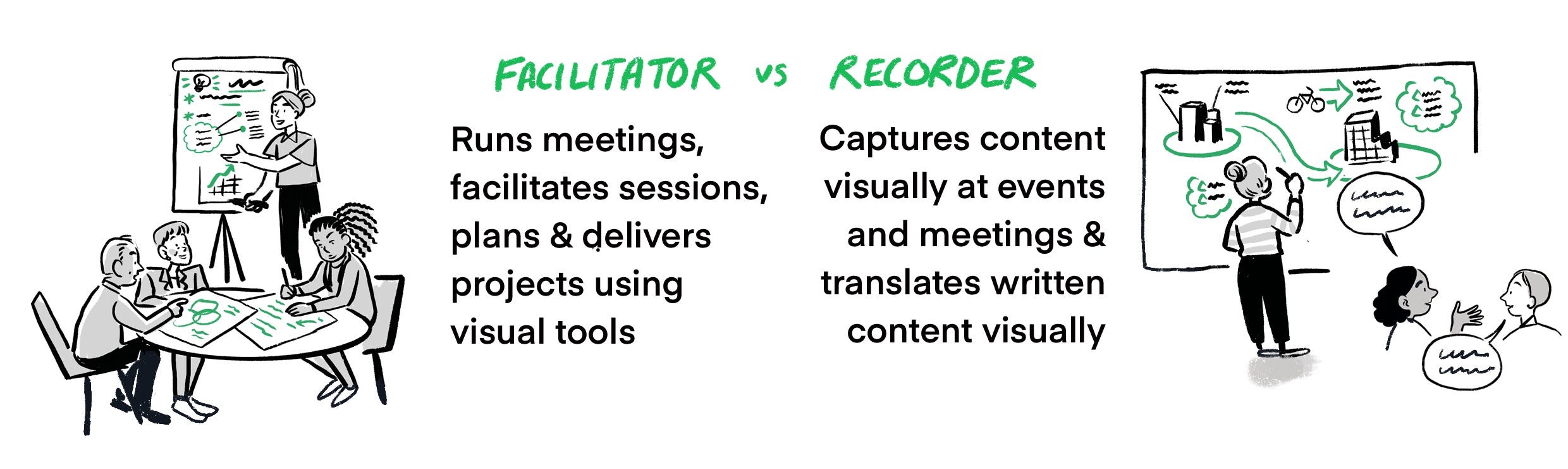
I know that there are some of you reading this who are curious about becoming a professional graphic facilitator or graphic recorder. Maybe you’re an illustrator and you’d like to add another income stream to your offering, or you have fantasies about leaving the office job and becoming a creative freelancer. Maybe you are a trainer or workshop leader and you’d like your content to be more engaging.
If this sounds at all like you then check out our online Graphic Change Academy courses.
I can tell you that you can as a practising graphic recorder you can earn back the cost of the course in one short gig. The game-changing bit of our 12 week courses isn’t the future potential (as exciting as that is), but the fact that I will be with you every step of the way.
If you join the course, here’s how it works:
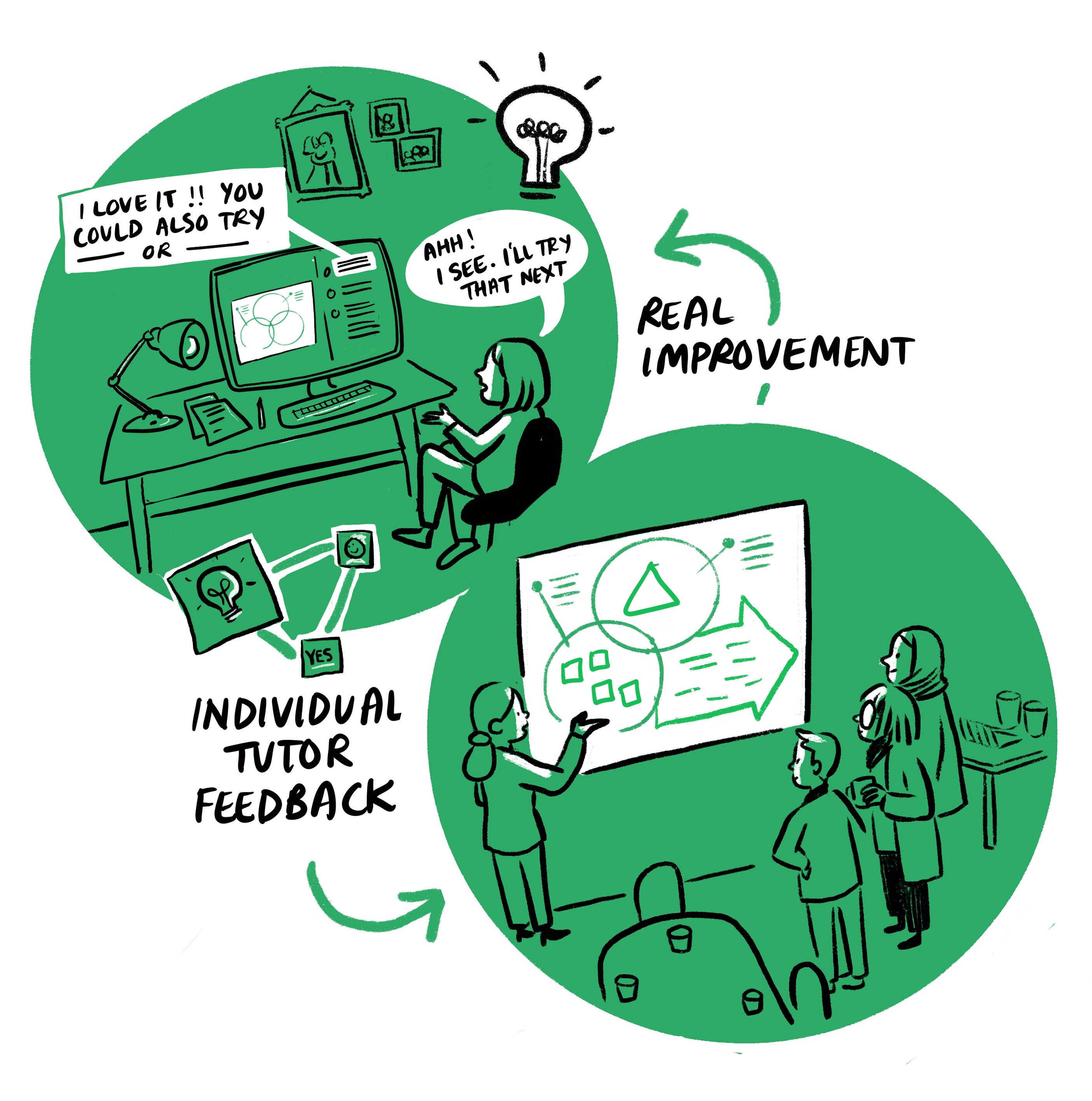
On your private dashboard that week’s lessons will open up for you - there’s usually 2 or 3 practical lessons, with videos, demos, pictures and text guiding you through. You do the lessons at a time that suits you and upload your work into our private community space. I then see your work and give you feedback. Not generic class feedback, but individual feedback on your work. You then take my feedback and suggestions and move forwards. Real growth of your knowledge and skills with support from a seasoned professional who’s been in the biz for 20 years.
If you want to know more there’s loads of info at the academy site and you can sign up to find out even more including feedback and examples of work from past students.

Bulletin board
If you have any relevant visual thinking news you’d like us to share, email Natasha at support@graphicchange.com
World Storytelling day is on the 20th March. If you’re already telling visual stories then it will be a good day to share your amazingness with the world and give your work a shout-out. If you’re not already telling visual stories then keep a look out for a Visual Storytelling course discount on that day.
Okay I promise I won’t mention the new term or our brilliant courses next issue, but we’re starting the new term of our deep dive courses Be a Graphic Recorder and Be a Graphic Facilitator, so if you’ve been on the fence about joining now’s the time to jump in. OR if you have questions (and who doesn’t have some questions?!) then hit reply to this email and ask away.
Right that’s it for now.


If you’re enjoying The Visual Edit then you can help support us by doing these two simple things:
Tap the LIKE button
Share with a visual thinking friend
You can also:
Find out more about our courses at the Graphic Change Academy
Join the graphic recorder club here
Buy my book Draw a Better Business
If you enjoy this newsletter, I’d really appreciate you sharing and recommending this publication to your network and visual thinking friends.